


 中文
中文 English
 Deutsch
 Italiano
 한국어
한국어 にほんご
にほんごComplete Engineering Guide for OEM Manufacturers and PV System Designers
Introduction
Photovoltaic (PV) systems are designed to deliver long-term, stable power generation under outdoor environmental conditions. However, one of the most underestimated reliability risks in solar installations is thermal stress and localized overheating.
Heat accumulation occurs continuously in key PV components such as solar junction boxes, inverters, connectors, and energy storage interfaces. Over time, excessive temperature can lead to insulation degradation, power loss, accelerated component aging, or even fire hazards in extreme cases.
To mitigate these risks, modern PV systems increasingly rely on photovoltaic thermal protectors—compact, temperature-sensitive switching devices designed to interrupt or control electrical circuits when abnormal thermal conditions are detected.
This guide explains how photovoltaic thermal protectors work, where they are used, and how engineers should select the right solution for solar energy applications.
What Is a Photovoltaic Thermal Protector?
A photovoltaic thermal protector is a temperature-triggered safety device used in solar power systems to prevent overheating-related failures.
It automatically responds to abnormal temperature rises by opening or interrupting the electrical circuit, protecting critical PV components from thermal damage.
Unlike current-based protection devices (such as fuses), photovoltaic thermal protectors operate based on direct temperature sensing, making them especially effective in scenarios where heat buildup occurs without immediate overcurrent conditions.
Primary Function
The core function of a photovoltaic thermal protector is:
To prevent thermal failure in PV systems by disconnecting or controlling the circuit before temperature reaches damaging levels.
Why Thermal Protection Is Critical in Photovoltaic Systems
Solar power systems operate in environments exposed to continuous thermal loading:
· High ambient temperature exposure
· Direct solar radiation heating
· Continuous DC power operation
· Enclosed installation structures (junction boxes, inverters)
Unlike many industrial systems, PV equipment often operates 24/7 with limited active cooling, making passive thermal safety design essential.
Without proper thermal protection, systems may experience:
· Junction box diode overheating
· Connector resistance heating
· Inverter capacitor aging
· Cable insulation breakdown
· Reduced conversion efficiency
· Fire risk in extreme cases
As system power density increases, thermal protection is no longer optional—it is a core safety requirement.
Where Overheating Occurs in PV Systems
1. Solar Junction Boxes
Junction boxes contain bypass diodes and electrical connections. Poor contact resistance or shading-induced current imbalance can generate localized heating, creating a hotspot risk.
2. Solar Inverters
Inverters convert DC to AC power and are one of the most heat-intensive components in PV systems. Power switching losses and compact design contribute to continuous heat generation.
3. PV Connectors and Cabling
High current DC transmission through connectors can lead to resistive heating, especially under aging or improper installation conditions.
4. Energy Storage Systems (Optional Integration)
In PV + storage systems, battery modules introduce additional thermal risks, including cell imbalance and thermal runaway potential.
How Photovoltaic Thermal Protectors Work
Most photovoltaic thermal protectors operate using bimetallic thermal switching technology combined with snap-action mechanisms.
1. Bimetallic Temperature Sensing Principle
A bimetallic strip consists of two metals with different thermal expansion coefficients bonded together.
When temperature increases:
· One metal expands faster than the other
· The strip bends due to differential expansion
· At a calibrated temperature threshold, mechanical deformation triggers switching action
· The circuit is opened, stopping current flow
This relationship can be expressed as:
ΔL = αL₀ΔT
Where thermal expansion directly determines mechanical displacement.
2. Snap-Action Switching Mechanism
Photovoltaic thermal protectors typically use snap-action structures to ensure fast and stable switching behavior.
Key advantages include:
· Rapid ON/OFF transition
· Reduced electrical arcing under DC load
· High switching reliability under thermal stress
· Long operational lifespan
This is particularly important in PV systems where DC arcs are more difficult to extinguish than AC systems.
3. Circuit Interruption Behavior
When the trip temperature is reached, the thermal protector:
· Opens the normally closed (NC) circuit
· Stops current flow immediately
· Prevents further heat generation
Depending on system design, the device may be:
· Self-resetting after cooling
· Manually reset for safety-critical applications
· One-time cutoff for fail-safe protection
Key Application Areas in Photovoltaic Systems
Solar Inverter Protection
Thermal protectors help prevent overheating in power conversion circuits caused by continuous switching losses.
PV Junction Box Protection
They provide protection against diode overheating and connection failure due to current imbalance or resistance rise.
DC Distribution Systems
Used in combiner boxes and distribution units to ensure stable thermal behavior under high current load.
Energy Storage Integration Systems
In hybrid solar + storage systems, thermal protectors add an additional safety layer against abnormal temperature rise.
Key Selection Criteria for PV Thermal Protectors
1. Operating Temperature Range
Selection must match system thermal profile, typically slightly above normal operating temperature but below damage threshold.
2. DC Load Capability
Photovoltaic systems operate under DC conditions, requiring high reliability under arc-prone switching environments.
3. Environmental Resistance
Outdoor PV installations require resistance to:
· UV exposure
· Humidity and condensation
· Dust and corrosion
4. Mechanical Installation Position
Thermal response accuracy depends heavily on installation location near heat generation zones.
5. Service Life and Stability
Long-term calibration stability is critical for 20–25 year PV system lifecycles.
Design Considerations for Engineers
For optimal system integration:
· Place thermal protectors close to thermal hotspots (diodes, power modules)
· Avoid thermal lag caused by poor mounting contact
· Combine thermal protection with overcurrent protection devices
· Ensure redundancy in critical safety circuits
· Validate performance under full load and peak solar irradiance conditions
Photovoltaic Thermal Protector vs Traditional Thermal Protection Devices
Feature | PV Thermal Protector | Traditional Industrial Thermal Protector |
Operating environment | Outdoor, UV exposure | Indoor / controlled environments |
Electrical type | DC-heavy systems | AC/DC mixed systems |
Thermal profile | Continuous solar heating | Cyclic load variation |
Safety requirement | Fire prevention critical | Equipment protection focus |
Photovoltaic systems require higher emphasis on long-term stability and environmental resilience compared to standard industrial applications.
System-Level Importance of Thermal Protection in PV Design
As photovoltaic systems evolve toward higher power density and compact modular design, thermal stress becomes increasingly concentrated.
Photovoltaic thermal protectors play a key role in:
· System safety architecture
· Fire risk mitigation
· Component lifetime extension
· Compliance with international safety standards
· Reduction of maintenance and downtime costs
In modern PV engineering, thermal protection is a foundational element of system reliability rather than an optional safeguard.
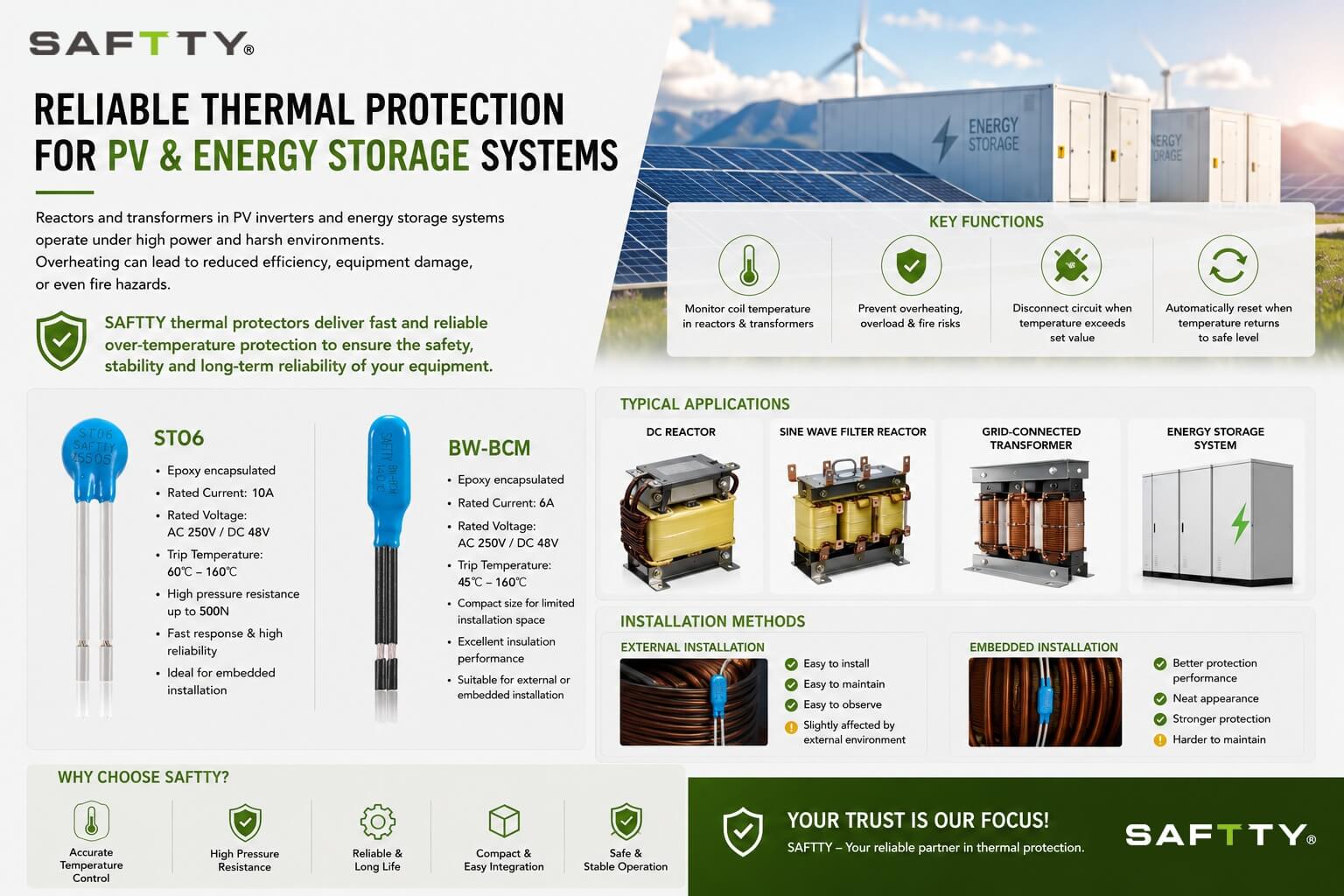
SAFTTY Photovoltaic Thermal Protection Solutions
SAFTTY provides high-reliability thermal protection components designed for demanding photovoltaic and energy system applications.
SAFTTY thermal protectors are widely used in:
· Solar inverter systems
· PV junction boxes
· Energy storage integration systems
· DC power distribution modules
Key advantages include:
· Precise and stable temperature triggering
· Fast snap-action switching performance
· High resistance to environmental stress
· Long service life under continuous operation
· OEM/ODM customization capability
By combining advanced thermal sensing materials with strict manufacturing control, SAFTTY supports photovoltaic system manufacturers in improving product safety, reliability, and long-term operational stability.
Conclusion
Photovoltaic thermal protectors are essential safety components in modern solar energy systems. By responding directly to abnormal temperature rise and interrupting electrical circuits, they prevent thermal damage, reduce fire risks, and improve long-term system reliability.
As PV systems continue to scale in power and complexity, integrating robust thermal protection is a critical engineering requirement rather than a secondary consideration.
For OEM manufacturers and system designers, selecting the right photovoltaic thermal protector is a key decision that directly impacts safety performance, compliance, and lifecycle cost efficiency.


